
|
By: Eda Ruhiye Uca 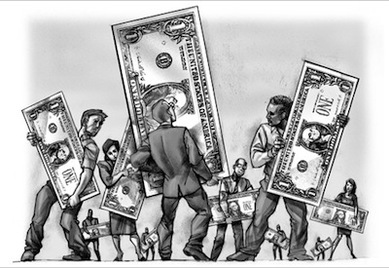 In The Talking Book: African Americans and the Bible(New Haven, Yale University Press, 2006), Allen Dwight Callahan illuminates the unique history of African American exegesis, highlighting especially Exile, Exodus, Ethiopia, and Emmanuel. In it, Callahan takes on the American myth and the grotesque irony that “the land that the Puritan founders called the Promised Land has been Pharaoh’s Egypt for African Americans”, a ‘promised land’ beyond reach of a people without the resources to take it; as put by freed man, Charles Davenport: “how us gwine a-take lan’ what’s already been took?”1 Callahan’s thesis is that which was the vast gulf between the political and religious experiences of Puritans and Africans in North America continues on in their descendants today. The breadth of his brilliant book will not be summarized by this writer here. (You’ll have to read it for yourselves.) Yet in the face of crumbling gains in wealth among African Americans Callahan’s thesis takes on a renewed urgency for those followers and friends of Jesus who are aching for racial reconciliation. The heart of the founders’ story, the taking of a Promised Land after harrowing exodus (ironically, from European persecution), is indeed the heart of the fracture in North American Christianity. White Southern preachers “taught” their captive audiences that the Exodus was a historical event not to be repeated in their own time while Africans prayed in secret to the God who set the captives free. Callahan writes, “the immediacy of African Americans’ identification with the oppressed children of Israel … marked the vast gulf in the religion of the master and the religion of the slave” and “allowed them to acknowledge the enormity of slavery and their own incapacity to do anything about it, while at the same time maintaining an expectation that God would make a way out of no way. This admixture of haplessness and hope was the faith of the slave”.2
Thus, Callahan suggests, while the Puritans and their descendants prayed in patriotic thanksgiving for lives of liberty and privilege in the North American colonies and, later, United States, enslaved Africans, freed people, and their descendants, took up the mantle of Moses, always leading to the Promised Land but never quite realizing the dream of true equality. He writes, “at best, African Americans are stalled at the ‘Deep River,’ as one Negro spiritual refers to the Jordan, languishing somewhere on the plains of Moab” and they will “only ever dwell in the land of milk and honey if they enter it through collective action”.3 Those wondering if Callahan is exaggerating the disparity between the descendants of Puritans and those they enslaved should note that a Brandeis University study in 2010 showed that the wealth gap between whites and blacks increased fourfold between 1984 and 2005.4 Just this past summer a Pew Research Center study revealed that the economic downturn erased even modest gains of the past; white Americans now have a net worth on average 20 times the net worth of African Americans. (Latino Americans are just barely ahead, having a 1:18 ratio of net worth to their white counterparts.)5 As the economic indicators of our collective failure to address white supremacy are folded into Callahan’s insights I wonder: Where is the holy and righteous anger over such reports that African Americans have now on average $5 of wealth for every $100 of white Americans? True, these types of reports get lost in the 24 hour news flash flood (The wealth gap! The looming elections! The raging crisis in Somalia!) and frankly, our racism and our internalized oppression blunts our ability to react. There is this, too: there is something so shocking, so depraved, so devastating about the truth that it’s impossible process it outside of the sustained efforts of a supportive community. Many of those whom I spoke to about the 1:20 wealth disparity thought that it just could not be true. Even when I showed them mainstream articles that verified the straight forward Pew Research Center report, their eyes glazed over as if to say, They must have made a mistake. Surely a retraction will be issued shortly. But no retraction is forthcoming from the Pew Center nor Callahan. The truth stands. How will we stand up to it? My first instinct is usually to do something. Yet the instinct to act must be undergirded by a realistic view of the world if it is to have just effect. Lutheran womanist theologian Rev Dr. Beverly Wallace writes, “according to Lutheran ethicist Reinhard Hutter, the first question should not be, ‘What ought I do?’” but rather “’What does the world really look like?’… Only in the inclusion of multiple perspectives can we know more fully the picture of humankind, the needs of God’s people, and how to respond more appropriately to the brokenness within the family of God. Ethics… must emerge from a thorough exploration and understanding of the care of all God’s people from the voices of all God’s people”.6 If Callahan’s thesis is right (and I submit that it is) then white and black Christians- even within the same denominations, neighborhoods, and churches- have developed some divergent views on what would make for biblical justice. Wallace suggests that our communities must become serious about understanding such differences and develop integrated visions of justice if we are to become equipped to act effectively. This type of integrated vision must be realized institutionally, academically and, of course, relationally in our churches, missions, and movements. But the fact is that only 5% of our churches are racially integrated- meaning that 20 percent of the congregation is made up by a racial group not in the majority- and half of those churches are on their way to becoming all-black or all-white. This being the case we must shift our discourse from building diversity alone to building meaningful relationships between historically white and historically black institutions. The latter may require an uncomfortable bold faced honesty about the world as it is. It’s true that the Church was not meant to be segregated and the aim of the Church should always lean toward unity. But today, we are mostly segregated in our faith communities and many people find it too difficult to sustain the level of hospitality that building truly racially integrated communities requires. Churches, missions, and movements that are unaware of anti-oppressive approaches to Bible study, retelling the story of God, and building the community of God may find their efforts at “diversity” leading more so to conflict or discord (and even trauma) than to community.7 Perhaps a more honest step towards reconciliation (which may or may not be racial integration in the immediate sense) is building meaningful relationship based on mutual respect, prayer, friendship, and solidarity.8 To build such relationships, I suggest that our churches, missions, and movements become familiar with the histories, strategies, and theologies of racially integrated movements which coalesce diverse viewpoints into liberative aims and means for all.9 This new-old way of building community must become the model to replace unidirectional mission as the modus operandi for the Church in the 21st century. That is, if we are all to cross the River Jordan. Notes:
Comments
|
Disclaimer
The viewpoints expressed in each reader-submitted article are the authors own, and not an “official Jesus Radicals” position. For more on our editorial policies, visit our submissions page. If you want to contact an author or you have questions, suggestions, or concerns, please contact us. CategoriesAll Accountability Advent Anarchism Animal Liberation Anthropocentrism Appropriation Biblical Exegesis Book Reviews Bread Capitalism Catholic Worker Christmas Civilization Community Complicity Confessing Cultural Hegemony Decolonization Direct Action Easter Economics Feminism Heteropatriarchy Immigration Imperialism Intersectionality Jesus Justice Lent Liberation Theology Love Mutual Liberation Nation-state Nonviolence Occupy Othering Pacifisim Peace Pedagogies Of Liberation Police Privilege Property Queer Racism Resistance Resurrection Sexuality Solidarity Speciesism Spiritual Practices Technology Temptation Veganism Violence War What We're Reading On . . . White Supremacy Zionism ContributorsNekeisha Alayna Alexis
Amaryah Armstrong Autumn Brown HH Brownsmith Jarrod Cochran Chelsea Collonge Keith Hebden Ric Hudgens Liza Minno Bloom Jocelyn Perry Eda Ruhiye Uca Joanna Shenk Nichola Torbett Mark VanSteenwyk Gregory Williams Archives
October 2017
|
Search by typing & pressing enter
 RSS Feed