
|
By: Brett Gershon 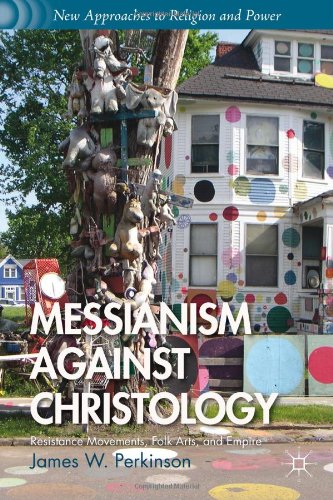 New hope is growing in places of abandonment as tendrils taking back what has been subsumed by so much concrete. While large scale urban abandonment in places like St. Louis, Baltimore, and Detroit has led to conditions of crushing poverty, fragmented family-life, and bleak, inhospitable cityscapes and living conditions for those abandoned there and with no means to escape, new possibilities of life are also opening that defy the present order. For so many of us caught in the thrall of the encroaching planetary crisis (like deer in headlights), not knowing where to turn and feeling sometimes ourselves simultaneously coaxed into a dull passivity and desperately abandoned to be consumed by the appetites of the powerful, the crumbling urban center stands as both sign of ruin to come and beacon of hope and possibility.
James W. Perkinson’s latest book, Messianism, Against Christology: Resistance Movements, Folk Arts, and Empire (Palgrave Macmillan, 2013) is contained within the deteriorating and vacant yet vibrant and bursting with life cityscape of urban Detroit as a road into what will be defined as “messianism”: the spirit of resistance which counters heinous and inappropriate systems of death with creative opening of new possibilities for life. Messianism breaks these possibilities wide open through the engaging of imagination and invocation of memory of prior ways of being more viable and in step with the rhythms of creation through folk mediums (storytelling, song, dance, etc.) and through embodying those memories in creative action. The spirit of messianism and the new possibilities it engenders occur under the influence and charisma of one who refuses to be contained by and who galvanizes a following against hegemonic control and into alternative economies based on reciprocity and more egalitarian lifeways. It is a sort of artful defiance that exists under any socio/political/economic order which counters oppressive power with creative energy and compassion.
Comments
2/28/2015 Comments I Had a DreamBy: Jim Tull  On an early May morning, 2014, I was fast asleep in a room in a house atop a mountain on the western edge of the Mojave Desert. There and then I had a dream. The otherwise busy dream featured a brief but vivid shouting match between me and Martin Luther King. No mistaking it was King. I was vaguely aware of what I was excited to share with my teacher [we never met in waking life], but the exchange did not last beyond this: Me “I have something to tell you!” [delivered with some enthusiastic intensity]
Martin “No, you listen to me!” [with escalated intensity] Me “No, you don’t understand!” [holding the intensity] Martin “No, you don’t understand!” [escalating a bit] Then Martin seamlessly vanished into the ether of the dream, which carried on with no apparent connection to this encounter (besides, stretching a lot, my brother-in-law and I noticing the high ocean tide gently lapping against the back of our beach house). It isn’t any more characteristic of me to engage in such substanceless shouting matches as it was of MLK. I recall, in the dream, wanting to sit down and have a certain dialogue, but he just let into me (of course, this is my reporting of the event!). In his response, no doubt, there is a message for me. But in the dream analysis meantime, I will settle for sharing, in a letter, the thought I was so excited to have the chance to run by Martin, but could not:
 For this month’s post, we decided to respond to people’s requests for more specific details and examples by sharing anonymous stories we solicited from people of diverse sexualities and gender identities. One of our aims was to highlight the often invisible diversity that exists in our communities and movement.
We know from the Gospel parables that Jesus conceptualized the Kingdom of God as an unexpected infiltration that brings renewal from the margins. In a sweeping act of rewilding, a weed diversifies a monocultural wheat field; an unclean culture infests and transforms a hard cracker into something more satisfying. Jesus says in the gospel of Matthew (13:31-33), “The kingdom of heaven is like a mustard seed that someone took and sowed in his field; it is the smallest of all the seeds, but when it has grown it is the greatest of shrubs and becomes a tree, so that the birds of the air come make nests in its branches.” He then tells another parable: “The kingdom of heaven is like yeast that a woman took and mixed in with three measures of flour until all of it was leavened.” That which has been excluded, including non-normative sexual experiences and people of marginalized identities, is often a crucial missing ingredient for realizing the kingdom.
 Those who don’t feel this Love pulling them like a river,
those who don’t drink dawn like a cup of springwater or take in sunset like supper, those who don’t want change, let them sleep. This Love is beyond the study of theology… I’ve given up on my brain I’ve torn the cloth to shreds and thrown it away -Rumi The comments to our first post were both confirming and challenging, and we will continue tailoring this series based on people’s responses. One question that emerged last time was, how does wildness include accountability in relationship? There is a growing trend in Christian moral theology to discern systems of sexual ethics that are less act-based and more relationship-based. The growing consensus among progressive Christians is that the substance or content of a sexual relationship (ex. consent, mutuality) is more important than its form (ex. gender, marital status). (For a good example of this, see Just Love by Margaret Farley of Yale Divinity School.) Theologians are also questioning secular liberalism’s respect for individual freedom held against the Christian norm of community. (Ex. Sex, Gender, and Christian Ethics by Lisa Sowle Cahill of Boston College.) Before proposing a new framework of sexual accountability of our own, we need to tease out what individualism and community look like from a specifically ecological Christian perspective.
 The ideas of civilization and the acts of colonization that seek to domesticate and control that which is inherently wild and good in God’s creation, depend on a mass of binaries—complexities of the natural and social world systemically and robotically reduced to digestible “opposites”. The opposites—male/female, straight/queer, white/black, rational/erotic, human/animal, among others—are assigned values in ways that serve to justify domination. Hierarchy first splits, then ranks; in the aforementioned set, it is clearly the first part of the binary that has been valued and the second that has been devalued.
As those who identify in some way with the Judeo-Christian tradition, we belong to a legacy that has participated in the construction of a dominant culture that legitimates these binaries and therefore devalues sexual and gender multiplicity, non-white peoples, non-human animals, women, the erotic, the body and unmediated creation in general. The oppression has been naturalized by the nation-state and claims of divine ordination. We also, thankfully, belong to a legacy of renewal, re-wilding, resurrection and total liberation. This is what we hope to reclaim and understand together. We believe this process involves examining and dismantling all aspects of ourselves and our world that have been infected by the logic of civilization, including our sexuality. By: Frank Cordaro 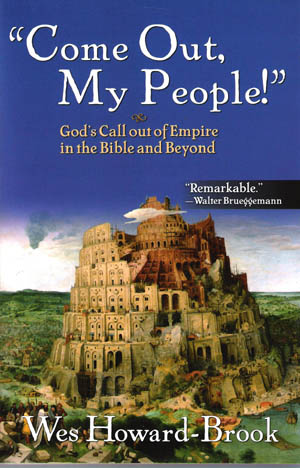 I have wanted to read this book for many years. It just was not written yet. Now that it is, we Catholic Workers and faith-based-nonviolent-resistance-to-the-USA-Empire type folks owe Wes Howard-Brook a debt of gratitude. Not since reading Ched Myers’s ground-breaking Binding the Strong Man has a book so influenced my reading of the scriptures. What Myers did with the Gospel of Mark, Howard-Brook does for the whole Bible by laying out a template for reading it.
Come Out, My People! addresses two major issues that have plagued my reading of the Bible. The first is the seeming great divide between the New and Old Testaments, or what we Christians have called our “Jewish question.” James Carroll’s book Constantine’s Sword, documents this tragic misreading of the scriptures and the bloody history that has followed. The current political discourse surrounding the State of Israel shows that these issues are still very much with us and not going away anytime soon, My second issue surrounds the question of violence in the Bible. Jack Nelson-Pallmeyer’s book Jesus Against Christianity highlights this perplexing issue well. Nelson-Pallmeyer asks the question, how are we who believe in the nonviolent Jesus and the unconditionally loving God of unlimited forgiveness with the violent deeds attributed to God and God’s people in the Bible? Nelson-Pallmeyer‘s answer is a bold and liberating one. If we really believe in that Jesus and that God, then where ever God is portrayed as violent in both the New and Old Testaments, the violence is human pathology imposed on the text. I find Nelson-Pallmeyer’s answer very appealing. It rings true in my spiritual guts. Yet it is somehow too convenient, too easy a solution. It does not adequately or systematically deal with the Bible’s violent biblical texts. |
Disclaimer
The viewpoints expressed in each reader-submitted article are the authors own, and not an “official Jesus Radicals” position. For more on our editorial policies, visit our submissions page. If you want to contact an author or you have questions, suggestions, or concerns, please contact us. CategoriesAll Accountability Advent Anarchism Animal Liberation Anthropocentrism Appropriation Biblical Exegesis Book Reviews Bread Capitalism Catholic Worker Christmas Civilization Community Complicity Confessing Cultural Hegemony Decolonization Direct Action Easter Economics Feminism Heteropatriarchy Immigration Imperialism Intersectionality Jesus Justice Lent Liberation Theology Love Mutual Liberation Nation-state Nonviolence Occupy Othering Pacifisim Peace Pedagogies Of Liberation Police Privilege Property Queer Racism Resistance Resurrection Sexuality Solidarity Speciesism Spiritual Practices Technology Temptation Veganism Violence War What We're Reading On . . . White Supremacy Zionism ContributorsNekeisha Alayna Alexis
Amaryah Armstrong Autumn Brown HH Brownsmith Jarrod Cochran Chelsea Collonge Keith Hebden Ric Hudgens Liza Minno Bloom Jocelyn Perry Eda Ruhiye Uca Joanna Shenk Nichola Torbett Mark VanSteenwyk Gregory Williams Archives
October 2017
|
Search by typing & pressing enter
 RSS Feed