
|
5/18/2012 Comments Prayer as Resistance, Part 1
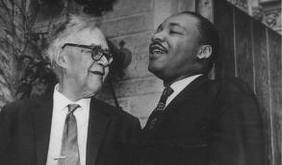 Karl Barth is reported to have once said “the clasping of the hands in prayer is the beginning of an uprising against the disorder of this world.”1 In this two part essay I will talk about Barth’s understanding of prayer as a form of Christian resistance. Barth (1896-1969) was the most prolific and influential Protestant theologian of the twentieth century. I will not attempt to introduce him here. But I hope that what I have written will be accessible and helpful even to those who have only read a little of Barth or never read him at all (or perhaps even heard of him!). Whether we are interested in Barth or not, the central issue for this essay is significant for everyone. How do we understand the relationship between our private and public lives as followers of Jesus? How is spirituality related to politics? What does prayer have to do with resistance? I find Barth’s thoughts on this to be a compelling proposal for thinking about the unity of prayer and politics. Rather than understanding prayer as a withdrawal from the public square perhaps we should understand prayer as a primary form of worldly engagement. Part one will describe Barth’s understanding of Christianity as resistance. Part two will then describe how Barth understands prayer as a form of resistance. In his final lectures (published posthumously under the title The Christian Life)2 Barth expressed thoughts on the Christian’s place in the world that Jesus Radicals readers might find intriguing. Barth maps the situation of the Christian in three concentric circles: the world, the church, and the individual. He argues that when humanity seeks to live independently of God a complex set of “lordless powers” is unintentionally let loose.3 (Barth compares this to the story of the sorcerer’s apprentice.) He describes these powers under themes such as Leviathan, Mammon, Religion, Ideology, Technology, and gives them the feel of idols. The forces that are set loose claim our subjective loyalties and conform us to patterns of thought, feeling, and action that create and perpetuate human conflict. The Bible calls these forces “principalities and powers” (Col. 2:9).4 These lordless powers create a “kingdom of disorder.” This disordered kingdom is the repetitive and stale condition of the world. It is a world where true freedom cannot be found. The kingdom of disorder tries to create its own freedom yet finds itself in bondage. It seeks constant newness and finds itself trapped in an endless cycle of sameness. The repetitive, stale, enslaved disorder manifests itself in the world, the church, and the individual. Barth also discusses empire as a lordless power and a form of “political absolutism” that can come in many forms (even democratic forms). The “myth of the state” stands approximately “behind and above all government.”5 Hobbes’s Leviathan is the most prominent example Barth uses. Hobbes’s Leviathan is an alternative God-man, an alternative Christ. We find the beginning of the conception of “the idea of an absolute and lordless power concentrated at one point in one hand.” Hobbes’s state is a machine that produces, protects, and perpetuates its own power. In Barth’s view every type of state is infected with this virus: “no state of any kind is or has or will be immune to the tendency to become at least a little Leviathan.” This imperial polity allows only one of three options: 1) intoxication with the myth of the state itself; 2) assimilation without intoxication; or 3) “law-breaking opposition.”6 Reading this passage you can appreciate the ease with which some of those influenced by Barth (like Vernard Eller or Jacques Ellul) could find compatibility between Christianity and some form of anarchism. “God’s design” is something entirely new. It reflects a God who “will always be new to us.” God’s design is an “unthinkable thought” beyond human imagination that can only “come” through God’s unique act. Jesus is the “the new thing.”7 In Jesus we see lived out the primary and proper Creator-creature distinction. As Christians assume this stance of creature (not Creator), the presence of God becomes “actual” in the world. This stance embodies humanity’s proper place as creatures under God’s care and provision, faithfully learning to live without anxiety. The “Christian attitude”8 expresses itself in faith, obedience, and prayer. They are part of the “basic forms of the Church’s ministry.”9 They are distinct but never separate, and prayer is the most fundamental of the three. For Barth the Christian attitude forms the action-based foundation for theological reflection. In other words, theology is rooted in politics and spirituality. Christianity is resistance. The Christian attitude exerts a counter-imperial force. It is the form that Christian resistance takes to the disordered, lordless powers that rule over the world, the church, and the individual. The Christian practice of faith, obedience, and prayer also represents a worldly and material concern. Barth even refers to Christians as true “humanists” because the nature of their “militant revolt” works in favor of all humanity and does not discriminate between friend and foe. Christians share in the guilt and oppression of the world and recognize that their own righteousness is “imperfect, fragile, and highly problematical.” Christians express their solidarity with all of humanity in the struggle for justice. The call to faith is part of this struggle, but the Christian task cannot be limited to that. Christians must stand in solidarity with humanity by, in my words, “being there.” This will be a discerning “being there” that will sometimes affirm humanity’s efforts and sometimes question them; but it can never become so concerned with Christian purity (of whatever kind) that the “being there” becomes a “not” being there. Barth’s understanding of Christian resistance is humanistic, engaged, and non-sectarian. The church is the Holy Spirit in community but never confined to the community. Christian resistance is never merely for the sake of holding out against a majoritarian culture opposed to its values and purposes. Christian resistance is witness that works for social transformation. The church lives out the demonstration of God’s own partisanship for humanity. Just as God will not abandon creation, so Christians can never abandon their neighbors. Finally, the Christian attitude is not just resistance “to” the lordless powers and their malformation of human subjectivity. It is resistance “for” or better yet “towards” the “kingdom come” that Jesus commanded us to pray for. The second petition of the Lord’s Prayer “thy Kingdom come” is for Karl Barth a call to Christian resistance. That call will be examined in part two. Notes:
Comments
|
Disclaimer
The viewpoints expressed in each reader-submitted article are the authors own, and not an “official Jesus Radicals” position. For more on our editorial policies, visit our submissions page. If you want to contact an author or you have questions, suggestions, or concerns, please contact us. CategoriesAll Accountability Advent Anarchism Animal Liberation Anthropocentrism Appropriation Biblical Exegesis Book Reviews Bread Capitalism Catholic Worker Christmas Civilization Community Complicity Confessing Cultural Hegemony Decolonization Direct Action Easter Economics Feminism Heteropatriarchy Immigration Imperialism Intersectionality Jesus Justice Lent Liberation Theology Love Mutual Liberation Nation-state Nonviolence Occupy Othering Pacifisim Peace Pedagogies Of Liberation Police Privilege Property Queer Racism Resistance Resurrection Sexuality Solidarity Speciesism Spiritual Practices Technology Temptation Veganism Violence War What We're Reading On . . . White Supremacy Zionism ContributorsNekeisha Alayna Alexis
Amaryah Armstrong Autumn Brown HH Brownsmith Jarrod Cochran Chelsea Collonge Keith Hebden Ric Hudgens Liza Minno Bloom Jocelyn Perry Eda Ruhiye Uca Joanna Shenk Nichola Torbett Mark VanSteenwyk Gregory Williams Archives
October 2017
|
Search by typing & pressing enter

 RSS Feed