
 Generally, Jesus Radicals exists to explore the intersection of Christianity and anarchism. Most people think such a combination is an impossibility (or a delusion). It would be a mistake to suggest that bringing the two together is mere novelty. Most of the negative reactions to such an interplay are based upon misunderstanding. Most folks assume that anarchism is for angry youth who long for chaos and disorder. Other folks assume that Christianity is (and always has been) about domination. Both are unfortunate stereotypes that, while having some basis in reality, are gross over-simplified dismissals (though, in all fairness, it is easier to find evidence for the oppressiveness of Christianity than it is for the chaotic immaturity of anarchism).
Anyone who has called themselves a “Christian” or an “anarchist” for very long can tell you that neither “tradition” is easy to define. Neither is monolithic. And both are profoundly misunderstood. So talking about how they relate is a complicated task. This is why, at every year’s Jesus Radicals conference, we have a “primer” session on Christianity and Anarchism. For the past two years, I’ve participated as a presenter in that primer session. What follows is based upon those primers. Sarah Lynne Gershon helped present the primer at the 2011 conference, so her digital fingerprints can be found in this article as well. But such a primer doesn’t exist online. I’ve found some that attempt a solid-yet-brief explanation, but none of them seem sufficient. My goal here is to write a short series of essays that one could pass along to (confused) friends.
Comments
By: Frank Cordaro 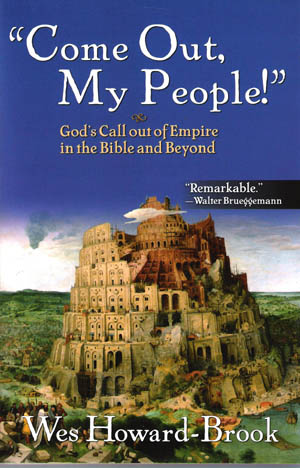 I have wanted to read this book for many years. It just was not written yet. Now that it is, we Catholic Workers and faith-based-nonviolent-resistance-to-the-USA-Empire type folks owe Wes Howard-Brook a debt of gratitude. Not since reading Ched Myers’s ground-breaking Binding the Strong Man has a book so influenced my reading of the scriptures. What Myers did with the Gospel of Mark, Howard-Brook does for the whole Bible by laying out a template for reading it.
Come Out, My People! addresses two major issues that have plagued my reading of the Bible. The first is the seeming great divide between the New and Old Testaments, or what we Christians have called our “Jewish question.” James Carroll’s book Constantine’s Sword, documents this tragic misreading of the scriptures and the bloody history that has followed. The current political discourse surrounding the State of Israel shows that these issues are still very much with us and not going away anytime soon, My second issue surrounds the question of violence in the Bible. Jack Nelson-Pallmeyer’s book Jesus Against Christianity highlights this perplexing issue well. Nelson-Pallmeyer asks the question, how are we who believe in the nonviolent Jesus and the unconditionally loving God of unlimited forgiveness with the violent deeds attributed to God and God’s people in the Bible? Nelson-Pallmeyer‘s answer is a bold and liberating one. If we really believe in that Jesus and that God, then where ever God is portrayed as violent in both the New and Old Testaments, the violence is human pathology imposed on the text. I find Nelson-Pallmeyer’s answer very appealing. It rings true in my spiritual guts. Yet it is somehow too convenient, too easy a solution. It does not adequately or systematically deal with the Bible’s violent biblical texts. 11/9/2010 Comments On Hope and AnarchismBy: Brenna Cussen Anglada  The epic movie “Reds” is based on the lives of the American socialist, journalist, and revolutionary Jack Reed (the only American to be buried at the Kremlin) and his wife and fellow writer, Louise Bryant. While the movie focuses heavily on the tumultuous and romantic relationship of the two characters, it also chronicles how Reed, along with his contemporary Emma Goldman, first ardently supported, and then became disillusioned by, the Bolshevist revolution in Russia. Watching the movie again last week, I was struck how this theme seems to play itself over and over in human history: passionate and well-meaning revolutionaries try to bring justice to the world—either through structural change, or violence, or both—but despite their best intentions, the institutions of power, in one form or another, ultimately prevail. Today there are social movements all around the globe attempting to bring about a better world—from voting in the “right” president or working through the international community, to blowing up buildings, buses, bridges, and dams or picking up arms and starting a rebellion. Behind all of these efforts exists compelling enthusiasm, righteousness, energy, and a willingness to sacrifice lives—both their own and others—for the sake of the cause. While I understand and often support the basic motivation of these activists (to ease suffering and restore justice) I find myself wary of the fundamental lack of hope their actions belie. Like for the characters in “Reds,” their admirable desire to create a perfect world eventually turns into desperation, because they believe that if they don’t do it, nobody will, and if justice is not achieved here on earth, it will never be achieved.
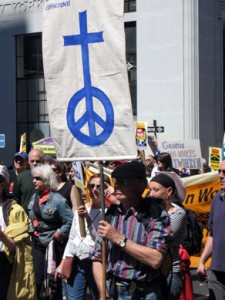 Editor’s Note: Make sure to read parts one, two, and three before this last part in Dan Oudhorn’s series challenging the somewhat flimsy ways we’ve tried to embrace the way of Jesus even as we accommodate the “death-dealing powers of our day.” Be forewarned–this is the most provocative part of the series.
All too often, those involved in Christian communities are so solely focused upon enacting a creative, life-giving alternative that they end up neglecting the concomitant work of resistance to the death-dealing powers of our day. This is a point I have inherited from cultural theorists and philosophers like Jean-Paul Sartre, Michel Foucault, and Jacques Derrida. If, in the context of death, we wish to participate in something that is new and life-giving, then we must simultaneously, if not first of all, engage in the destruction of that which is death-dealing. So, for example, taking feminism seriously requires us to not only ensure that women and men are accorded the same status and judged by the same standards; it also requires us to abolish previous structures, attitudes, and discourses that were patriarchal and androcentric. Or, to take a second example, we can see how the worship of YHWH necessarily requires the Israelites to destroy their idols in the Old Testament, and necessarily requires Jesus to overturn the tables of the moneychangers in the New Testament. Therefore, if we are hoping to be involved in communities of new creation, committed to life, love, solidarity, and justice; then we must also be committed to resisting and destroying that which is given over to death, hatred, alienation and injustice. It is not enough for us to simply focus upon being a creative alternative to the status quo. We must also attack the status quo. Doing so does not mean that we have given in to a “false soteriology”. I once thought this, given the way I have been influenced by the Duke School and scholars like Stanley Hauerwas and William Cavanaugh. Both Hauerwas and Cavanaugh have made convincing arguments that liberal democracies operate with a false soteriology and look to the State for salvation… when in actuality salvation is found in Christ and in the Spirit-empowered community of those who follow him. By: Michael Iafrate 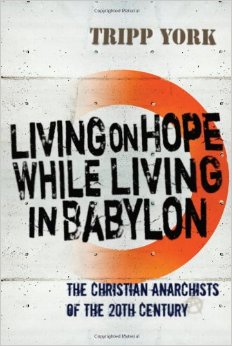 The publication of Tripp York’s Living on Hope While Living in Babylon marks a significant contribution to the recently re-emerging interest in the connection between Christianity and anarchism and for that reason should be celebrated. Very little scholarship exists regarding these questions, and the less these concerns remain marginal to political theology the better. The book is a revised version of York’s master’s thesis on anarchism and Christianity. Chapter one describes why Christianity and anarchism resonate with one another. Chapter two seeks to go beyond what York calls a merely “revolutionary” type of Christian anarchism toward what he calls an anarchistic “apocalyptic politics.” Chapters three through five each describe Christian individuals or movements whose praxis subverted the “triple axis of evil” of imperial politics described by Martin Luther King, Jr.: materialism, racism, and militarism. These chapters focus, respectively, on the Catholic Worker movement, Clarence Jordan of the Koinonia movement, and the Berrigan Brothers.
|
Disclaimer
The viewpoints expressed in each reader-submitted article are the authors own, and not an “official Jesus Radicals” position. For more on our editorial policies, visit our submissions page. If you want to contact an author or you have questions, suggestions, or concerns, please contact us. CategoriesAll Accountability Advent Anarchism Animal Liberation Anthropocentrism Appropriation Biblical Exegesis Book Reviews Bread Capitalism Catholic Worker Christmas Civilization Community Complicity Confessing Cultural Hegemony Decolonization Direct Action Easter Economics Feminism Heteropatriarchy Immigration Imperialism Intersectionality Jesus Justice Lent Liberation Theology Love Mutual Liberation Nation-state Nonviolence Occupy Othering Pacifisim Peace Pedagogies Of Liberation Police Privilege Property Queer Racism Resistance Resurrection Sexuality Solidarity Speciesism Spiritual Practices Technology Temptation Veganism Violence War What We're Reading On . . . White Supremacy Zionism ContributorsNekeisha Alayna Alexis
Amaryah Armstrong Autumn Brown HH Brownsmith Jarrod Cochran Chelsea Collonge Keith Hebden Ric Hudgens Liza Minno Bloom Jocelyn Perry Eda Ruhiye Uca Joanna Shenk Nichola Torbett Mark VanSteenwyk Gregory Williams Archives
October 2017
|
Search by typing & pressing enter
 RSS Feed