
|
By: Ric Hudgens 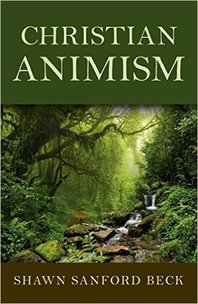 Shawn Sanford Beck’s short, suggestive essay (60 pages) on “Christian animism” is a provocative delight. I want to highlight some of his most salient points and indicate some further directions for those who want to go further. The Rev Shawn Sanford Beck is a priest in the Anglican Church of Canada. He lives with his family on an off-the-grid homestead in Saskatchewan. Beck writes:“To say that a Christian can, and should, cultivate a relationship with the spirits of nature, the spirits of the land, is something new. What was natural and somewhat unconscious up until the end of the medieval period now requires consciousness and intentionality.” But can’t we do that without calling it “Christian animism”? Beck argues that we need not fear animism, nor should we see the conjunction of Christian and animist as something so foreign or idiosyncratic. Christian animism according to Beck is “what happens when a committed Christian engages the world and each creature as alive, sentient, and related, rather than soul-less and ontologically inferior.” Christian Animism seems so exotic and frankly eccentric because we have all been indoctrinated into a “cult of reductionism” that reduces the world’s wondrous multiplicity to a series of justs: just a tree, just a rock, just the earth. In my own initial writing about Christian Animism I noted how the voices of creation have been bound and gagged by modernity so that only the human voice can be heard. Beck is defining Christian Animism through the lens of contemporary systems theory and an integral worldview. His type of contemporary Animism entails broadening the concept of person to include the rest of the created world: “animism can be reclaimed as a concept which sees the natural world as sentient, personable, and very much alive.” Long ago, Christian orthodoxy broadened the concept of person to include both God and humanity. Whether we see the personhood of God as primary or as a projection from human personhood the category already contains at least two members. Beck would add a few more! I agree with Beck that even historically earth-friendly forms of Christianity (his examples are the Franciscans and Rhinelander mystics) saw creation as a means to an end. I would add that American Transcendentalism was also prone to this with Emerson turning nature into symbol (not so Thoreau by the way). Beck also draws upon the contemporary fiction of C S Lewis and J R R Tolkien, the Christian spirituality of Celtic Christianity; and the political ontology of Walter Wink to demonstrate that forms of Christian Animism are already vitally present in Christianity. He could have incorporated more examples here (e.g. Teilhard de Chardin, Matthew Fox), but his point seems valid. We have not seen animistic elements within Christian sources because we have not looked for them. Perhaps Christian Animism is not an objectionable syncretism, but the reclaiming of the entire scope of divine presence that recognizes as Beck says that “there is ultimately more to our faith than God and the human soul.” I would call Christian Animism a species of radical incarnationalism (following theologian Sallie McFague). The implications of Animism (hinted at but not fully developed in the context of a monograph) include contributions to ecology, interfaith dialogue, and personal spirituality. I welcome Beck’s very personal story of how especially the work of Christian Walter Wink and Neo-Pagan Starhawk informed his journey in Christian Animism. What benefit I gain from bringing Wink and Starhawk into the discussion is the recognition that a newly articulated Christian Animism would be political to the core: “A truly green spirituality will engage us in the work of Earth-protection and Earth-healing.” I would add that it will also push us (esp in the Americas) to more intentional alliances with contemporary indigenous communities and their struggles. Christians have been major contributors to this desacralizing of the world and have shored up an oppressive anthropocentrism in the name of dominion or stewardship - as Beck notes merely the hard core and soft core versions of the same dynamic. But Beck does not concede any solid theological objections to Christian animism. Christian hostility and the conflicted relations between the two are partly the result of an avoidable confusion and confluence of animism with pantheism and polytheism. Beck confesses his lifelong struggle to reconcile his “inner pagan” with his faith in Jesus; and it is simply the case that many of us in the West are still dispositional pagans despite years of reductionist, secular and "christian" education. In marking his own trail Beck has found help from a number of different sources including Neo-Paganism, Engaged Buddhism, and Native American spirituality. Within the broader Christian tradition Becks says that the Book of Psalms is “thoroughly animistic” and that the Book of Enoch (quoted in the New Testament) “reveals a universe in which all created beings have a spiritual aspect”. From the Cree worldview Beck has learned that “newcomers (non-Indigenous people) would not truly find our place here in Turtle Island until we learned to engage with the spirits of the land.” This affirms the assertion of Calvin Luther Martin that North America truly remains undiscovered until this happens. I welcome Beck’s observation that the Native American Medicine Wheel represents a visual structure for expressing diversity within unity and the emphasis upon all beings having a place in the circle of life. I would add that the Apostle Paul writing for an indigenous culture might have employed the Medicine Wheel rather than the human body in 1 Cor 12. (Also, look at how animistic psychologist Bill Plotkin has utilized the Medicine Wheel / Four Directions structure in his most recent book Wild Mind). However, there are issues of cultural appropriation that emerging Christian Animists will have to seriously consider as we engage with indigenous traditions and symbols. We have to both discern the animist substructure of all human religious belief (our “original religion” as Charles Eisenstein has written) from the superstructure built upon those beliefs. The practice of Christian Animism requires a profound shift in consciousness with radical consequences. Perhaps only in striving to reawaken our primal connections with the more-than-human world will we become most fully aware of how alienated we are from that world. Celtic Christianity taught us that “The ability of the saints to cultivate such interesting relationships with animals was seen to be a sign of their growing sanctity.” Can Christian Animism move the church towards a new vision in which a deeper ecology becomes integral to a broader holiness?  Ric Hudgens is a "conspiratorial consultant" for ProActive: The Prophetic Activism Initiative: "creating spaces for God's freedom dreams". He is a perpetual newcomer to intentional Christian community at Reba Place Fellowship in Evanston, Illinois and pastor-in-residence at a local African-American congregation.
Comments
|
Disclaimer
The viewpoints expressed in each reader-submitted article are the authors own, and not an “official Jesus Radicals” position. For more on our editorial policies, visit our submissions page. If you want to contact an author or you have questions, suggestions, or concerns, please contact us. CategoriesAll Accountability Advent Anarchism Animal Liberation Anthropocentrism Appropriation Biblical Exegesis Book Reviews Bread Capitalism Catholic Worker Christmas Civilization Community Complicity Confessing Cultural Hegemony Decolonization Direct Action Easter Economics Feminism Heteropatriarchy Immigration Imperialism Intersectionality Jesus Justice Lent Liberation Theology Love Mutual Liberation Nation-state Nonviolence Occupy Othering Pacifisim Peace Pedagogies Of Liberation Police Privilege Property Queer Racism Resistance Resurrection Sexuality Solidarity Speciesism Spiritual Practices Technology Temptation Veganism Violence War What We're Reading On . . . White Supremacy Zionism ContributorsNekeisha Alayna Alexis
Amaryah Armstrong Autumn Brown HH Brownsmith Jarrod Cochran Chelsea Collonge Keith Hebden Ric Hudgens Liza Minno Bloom Jocelyn Perry Eda Ruhiye Uca Joanna Shenk Nichola Torbett Mark VanSteenwyk Gregory Williams Archives
October 2017
|
Search by typing & pressing enter
 RSS Feed