
|
By: Eda Ruhiye Uca 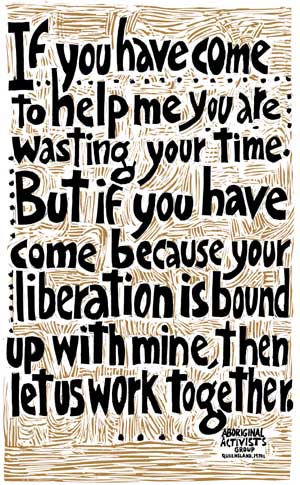 “Community”, “Radical Discipleship”, “Prophetic Witness”: An urgent and self-giving Christianity has taken hold of the imaginations of a new generation of the faithful. Group houses of sincere young folks earnestly desiring to live for Christ and serve the poor are springing up like daisies after a summer rain. It is humbling to witness the movement of the Spirit in their work. Yet it is mournfully apparent that the language, aims, and means of our Christian communities are often defined by a narrow contingent of the movement or what might be the movement if our communities were accountable to anti-oppression work and in solidarity with those under the foot of kyriarchy in its many forms. In fact, the voices of women, queer people, people of color, those of immigrant or non-North American status, the economically disadvantaged, and the disabled are often secondary to the voices of celebrated white heterosexual North American men. And while certainly, our God’s cause is the cause of the poor, there is something troubling about our communities’ rhetoric and movement “to the margins”: it is a dangerous sense of entitlement that gives some of us the notion to obtain property and create ministries and services- often while lacking training or outside accountability. Many community houses have been started without the members having first developed a meaningful relationship with the community leaders and projects already underway, without having been invited to come nor having undertaken a serious analysis of the kinds of unjustly gained power that make some service providers and others receivers of services. Yes, our God’s cause is the cause of the poor and the inspiration to give one’s life for God’s people- especially the most obviously vulnerable among us- is right and good. But the desire to give one’s life must not overcome a commitment to give that gift with a holy indifference that might lead one another way. (I am reminded of priests on foreign mission returning home, having been told that it was in disarming U.S. imperialism that they could best care for their beloved congregations abroad.) And while the lack of representation- and accountability- in our movements is casually acknowledged by many (“Sure, we’re mostly white, middle class, and male”), acknowledging it without committing to changing it perpetuates the unexamined privilege that underlies so many of our communities. It feeds the supremacy of whiteness, maleness, heterosexuality and class privilege in our most compelling “radical” North American Christian experiments and recreates the dynamics of oppression we name as sin. For when it is said that the Church- that is, we- serve the poor, the Church risks making itself something that is over-and-above, outside of, those who it has claimed are most precious to our community. What should be the role, the manner of discipleship of those of us who are impoverished- economically or politically or spiritually- if being “a Christian” is serving us? Must we remain sacrificial lambs for the altar? Proxies for God on and against whom some experience the faith (How I love to serve them!) on others (Thank you, ma’am.)? And then who exactly are the poor in need of service? Yes, “the poor” are those raising babies and grandbabies in highrise housing projects and flat suburbs lined with boarded up houses. Yes, “the poor” are running tractors at midnight on Saturday on struggling family farms or holding strong in tinny trailers shaken by the storm- Katrina, meth, one more brother in jail. “The poor” are also living in lands occupied by foreign military bases, threatened with nuclear annihilation, and terrified by war. There is more: “The poor” are those whose non-normative stories, bodies, and dreams often find them marginalized even among those who endeavor to work with and for them: the queer community, the women, the people of color, and people living with disabilities, among others. The soldiers demanding what would make for peace and getting in response only more parades are “the poor”, too. “The poor” are even those who- not knowing their own poverty- try to serve others without realizing the depth of their own need for liberation. The unidirectional models of our “radical” missions do not see this complexity of poverty, that is, the kyriarchy that must be untangled. Daily we read treatises of shallow liberation, trying to fit the causes of the We’s into the model of the Church (us) and the poor (them). It’s understandable how these missions came to be. Isaiah(s) railed in lonely witness against Kings. Jesus sends disciples two-by-two to preach the Good News. The Works of Mercy are handed down the millennia: Give to those who are thirsty a drink, feed the hungry, clothe the naked, visit the prisoner, bury the dead, and your reward will not be forgotten in Heaven. There are hundreds of instructions to serve. Yet there are little clues that we ought to listen or collaborate. This may have worked for some time. Yet in our postcolonial world, the old way of unidirectional mission- if it were ever sufficient- is no longer enough. And well supported though these missions may be in the our sacred texts, they do not sufficiently answer the cry for liberation that Jesus inspires in the hearts of those who are captive. Lila Watson’s qualification to those outside of her community is the essential invitation we are each faced with in this moment: If you have come to help me, go home. If you have come because your liberation is bound up in mine, then let’s work together. It’s not a matter of some of us giving more from our excess. We must, all of us, love God with all our hearts, minds and souls, love our neighbors as ourselves, love our enemies as God gives rain and sunshine to the righteous and unrighteous, and finally, love one another with the self-dying and liberating love with which Jesus loved us. For our own liberation rests in the liberation of our sisters and brothers. Here is the truth: We the poor, we the queer community, we the women, we the people of color, we the disabled, we the white folks, and we the men, we the Americans (of all the Americas) and we whose hope lies in other lands: we in the global community of humanity- all of the We’s- are the Mystical Body of Christ and where two or more of us are gathered, there is Jesus and there is the Church. We can wait for no man, no entity, no mission to launch into our midst. We must know the urgency to be with and for one another, to build missions of mutual exchange, to coalesce movements of solidarity. The old way of mission is not enough. We need a new-old kind of mission, a biblical mission whose time is come, that is, the mission of the Syrophoenician woman and Jesus to one another. We find this story of mission-in-the-round in the Gospels of Mark and Matthew: Jesus has the power to heal but keeps it for his own people; he calls her people “dogs”. She begs him to see her humanity, to love her not even as he loves his own but enough to extend his healing touch to her. It was only after Jesus heals her that he opens his ministry- healing, feeding, teaching, and ultimately dying- to Gentiles as well as Jews; to all of us. In order for Jesus to come to the wholeness of his ministry, in order for Jesus to become our cause to cry Hosanna, our blessed one who comes in the name of the Lord, in order for that, Jesus had to find liberation from the race dynamics which clouded his vision and privileged him in the community with which he most closely identified- destitute and revolutionary Jews. Now, the destitute and revolutionary Jews of first-century Rome needed their movement just as the We’s need our movements today. We must have space to tell our own stories, analyze the systems of oppression by our own compasses, to press forth our own dreams: we must do our own work. But we will only succeed if we recognize that the We’s have a common enemy in the powers and principalities of our own time: kyriarchy with all of its masks and names. We will only succeed if we become committed to one another’s people, movements, dreams, and liberation as we are our own. How can we start this new-old way? Here is the invitation: In the coming months, Hosanna! People’s Seminary will be launching the Hosanna! People’s Seminary Communities Initiative. Our inaugural program will be a five-part Lenten “learning/teaching circle” on oppression and liberation in Christian community. Participants will have an opportunity to build community and explore the issues of sex-positive, anti-racist, anti-classist community building. (And, yes, there is such a thing as sex-positive celibacy!) Come be a part of this new experiment in truth: Let’s enter into one another’s stories and learn to be serious- in thought, word, and deed- to what makes for Good News for each of us. Let’s be woven into a seamless garment that cannot be torn asunder by the powers and principalities ruling the nations and our own feeble hearts. Then the whole world will look at us and say: Look! Look how they love one another.
|
Disclaimer
The viewpoints expressed in each reader-submitted article are the authors own, and not an “official Jesus Radicals” position. For more on our editorial policies, visit our submissions page. If you want to contact an author or you have questions, suggestions, or concerns, please contact us. CategoriesAll Accountability Advent Anarchism Animal Liberation Anthropocentrism Appropriation Biblical Exegesis Book Reviews Bread Capitalism Catholic Worker Christmas Civilization Community Complicity Confessing Cultural Hegemony Decolonization Direct Action Easter Economics Feminism Heteropatriarchy Immigration Imperialism Intersectionality Jesus Justice Lent Liberation Theology Love Mutual Liberation Nation-state Nonviolence Occupy Othering Pacifisim Peace Pedagogies Of Liberation Police Privilege Property Queer Racism Resistance Resurrection Sexuality Solidarity Speciesism Spiritual Practices Technology Temptation Veganism Violence War What We're Reading On . . . White Supremacy Zionism ContributorsNekeisha Alayna Alexis
Amaryah Armstrong Autumn Brown HH Brownsmith Jarrod Cochran Chelsea Collonge Keith Hebden Ric Hudgens Liza Minno Bloom Jocelyn Perry Eda Ruhiye Uca Joanna Shenk Nichola Torbett Mark VanSteenwyk Gregory Williams Archives
October 2017
|
Search by typing & pressing enter

 RSS Feed