WWW.JESUSRADICALS.COM
  • About
  • Rock! Paper! Scissors!
    • What's in a Name?
    • Submission Guidelines
    • Call for Content
    • Past Issues >
      • Blog Archives (2005 - 2017)
      • Liberation for Every Body
      • The Movement Makes Us Human
      • Truth, Trust, and Power
      • Art Against Empire
      • Earth, Ecology, and the End of the Age
      • Decolonization, Incarnation, and Liberation
  • Library
    • Add an entry
    • Letter A >
      • Abelism
      • Accountability
      • Ally
      • Anarchism
      • Animal Liberation
      • Anthropocentrism
      • Assimilation
    • Letter B >
      • Base Communities
      • Biblical Exegisis
    • Letter C >
      • Capitalism
      • Catholic Worker
      • Civilization
    • Letter D >
      • Decolonization
      • Direct Action
    • Letter F >
      • Factory Farming
      • Feminism
      • Foraging
    • Letter G >
      • Genocide
      • Globalization
    • Letter H >
      • Heteropatriarchy
      • Humane Killing
    • Letter I >
      • Internalized Oppression
      • Intersectionality
    • Letter L >
      • Liberation Theology
    • Letter M >
      • Marginal Voices
      • Mass Media
    • Letter N >
      • Nonviolence
    • Letter O >
      • Othering
    • Letter P >
      • Pedagogies of Liberation
      • Police
      • Privilege
    • Letter Q >
      • Queer
    • Letter R >
      • Racism
      • Resurrection
    • Letter S >
      • Speceisism
      • Spiritual/Cultural Appropriation
      • State
    • Letter T >
      • Technology
      • Theopolitics
    • Letter V >
      • Voting
    • Letter W >
      • War
      • White Supremacy
  • Iconocast
    • Collective
    • Canvas
  • Donate
  • Contact
  • Join Us
  • About
  • Rock! Paper! Scissors!
    • What's in a Name?
    • Submission Guidelines
    • Call for Content
    • Past Issues >
      • Blog Archives (2005 - 2017)
      • Liberation for Every Body
      • The Movement Makes Us Human
      • Truth, Trust, and Power
      • Art Against Empire
      • Earth, Ecology, and the End of the Age
      • Decolonization, Incarnation, and Liberation
  • Library
    • Add an entry
    • Letter A >
      • Abelism
      • Accountability
      • Ally
      • Anarchism
      • Animal Liberation
      • Anthropocentrism
      • Assimilation
    • Letter B >
      • Base Communities
      • Biblical Exegisis
    • Letter C >
      • Capitalism
      • Catholic Worker
      • Civilization
    • Letter D >
      • Decolonization
      • Direct Action
    • Letter F >
      • Factory Farming
      • Feminism
      • Foraging
    • Letter G >
      • Genocide
      • Globalization
    • Letter H >
      • Heteropatriarchy
      • Humane Killing
    • Letter I >
      • Internalized Oppression
      • Intersectionality
    • Letter L >
      • Liberation Theology
    • Letter M >
      • Marginal Voices
      • Mass Media
    • Letter N >
      • Nonviolence
    • Letter O >
      • Othering
    • Letter P >
      • Pedagogies of Liberation
      • Police
      • Privilege
    • Letter Q >
      • Queer
    • Letter R >
      • Racism
      • Resurrection
    • Letter S >
      • Speceisism
      • Spiritual/Cultural Appropriation
      • State
    • Letter T >
      • Technology
      • Theopolitics
    • Letter V >
      • Voting
    • Letter W >
      • War
      • White Supremacy
  • Iconocast
    • Collective
    • Canvas
  • Donate
  • Contact
  • Join Us
Search by typing & pressing enter

YOUR CART

Rock! Paper! Scissors!
 Tools for anarchist + Christian thought and action

Vol 1. No. 2 ​
Liberation for Every Body: 
Toward New Futures with Other Animals

Guest editor: Nekeisha Alayna Alexis
Photo courtesy Jo-Anne McArthur / We Animals.
9/28/2018 Comments

“My people will be healthy, happy, thriving , powerful”: An interview with Jamila Anahata, Afro Vegan Society

 Afro Vegan Society is a non-profit organization in Baltimore, Maryland. It's goal is to is empower our community by using veganism as a tool to overcome systemic race-based oppression shared among those who have a common African ancestry." It's works toward this mission through community engagement, event planning, providing vegan resources, and writing, Nekeisha Alayna Alexis interviewed Jamila Anahata, Community Engagement Director. Below is their conversation, edited for clarity. 
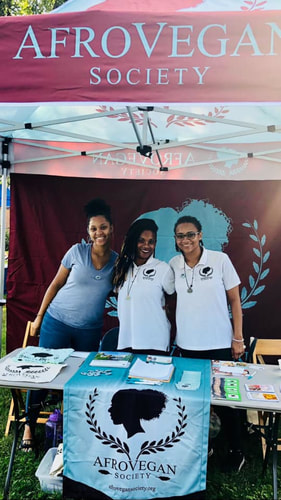
PictureZeki Kelton, Jamila Anahata and Maya Alfred at the 2018 table for Afro Vegan Society at the Charlottesville Vegan Roots Fest. Photo provided.
NAA: We’re talking today because you are part of Afro Vegan Society. Do you want to say a little bit about what that is and what your role is there?
Jamila: Sure! So Afro Vegan Society, we’re very food justice-, community-, and, well, I don’t want to say health-based, but we do understand the benefits of a plant-based diet. We do want to move people away from eating more processed food, but we understand that with food injustices in Black and Brown neighborhoods, that’s not necessarily a huge priority. We do community engagement events. So we have the Baltimore Black Vegan Social Group Meetup that meets every month where we make food ourselves for free for everybody in the community (if you’re Black of course). I can tell that people really enjoy the food—especially since it’s made from scratch and love. We have events [such as] cooking demos. We’re having a Cooking Demo Extravaganza coming up in November, which we’re really excited about. We haven’t really advertised for that yet, but we’re definitely going to have some great demonstrators there; some people who are local and have a name. We like to do that so people understand what vegan cooking looks like; you’re not shaving a celery stalk, you’re not just going to be eating three carrots and that’s it. There’s so many things you can eat. From what I remember, there’s about 30,000 – 80,000 edible plants on earth.

We try to take those things that are available to us, especially in local DC and Baltimore, and make that a thing. And by season, showing people what seasonal looks like; showing them what vegan-on-the-go looks like; vegan on a budget; how to transition your kids to going vegan; things along those lines. So we do a lot of exciting work. We also have our website. We have a lot of vegan resources [on there]. There are recipes and something called the Black-Owned Vegan Restaurant List. That’s something that’s really good for a national audience just so people, when they’re traveling, they can go out and support their local Black business and have some good food on top of that. We’re just really for the community. We just want to make sure that Black people are transitioning easily to a vegan lifestyle.

NAA: You all are based in Baltimore, but I feel like I’ve seen you all travel as well. Where else have you been hitting up with Afro Vegan Society?
Jamila: Last November we did a Vegan Soul Food Search where the AVS team went across the East Coast and parts of the Midwest, hitting up Black-owned vegan restaurants that were on our list. That was pretty fun! There were a few [restaurants] that popped up that we didn’t even know existed, and some didn’t pop up at all. So it was a great experience. We got to meet face-to-face with the people that we interact with online. There were people who live in Chicago or North Carolina that we haven’t really gotten to talk to [in person] but we’re best friends on Facebook or Instagram. So it was really good to see their faces and hear their words and just experience vegan soul-food in another state. We do try to make it more national. That’s why we have our recipes and our resources online but for the most part we’re really local.

NAA: How long have you been vegan and what prompted you to go in that direction?
I’ve been vegan for almost 5-1/2 years now. I’ve always had health problems from childhood and even now it kind of lingers. I had digestive issues because I ate the SAD diet—the Standard American Diet – just like everybody else. Pizza, burgers, fries—I just did not stop. I didn’t look at a vegetable until I basically went vegan. My body was screaming for my attention to finally give it some nourishment and I listened. I finally listened. So once I looked up my diet and understood that animal products were the cause of my issues, that was almost enough for me to quit altogether but I also watched Earthlings. I never really considered myself an animal lover or anything. I do love animals: I have a great, deep appreciation for them but you’re not going to see me licking a dog’s face. But seeing that [film]was really what made me… I just don’t want to support that at all. I just could not do it anymore.

I also wanted to be an example for my people. Actually, contrary to popular belief, veganism is pretty common in the Black community: we just don’t talk about it enough and we don’t really explore those circles because they can be deemed as White. For some reason, we associate eating fried chicken and eating the worst of the worst food with being Black, but that’s the complete opposite [of the truth]. That is something we’ve been conditioned to believe. So those notions really did help me stay vegan because I knew that the more I was vegan, the more I cooked, the more I showed people my smoothies, the more I gave information about veganism, that my people would follow along. So here I am.

NAA: You touched on the ways being vegan as a Black woman helps to dismantle these myths around “This is what Black people eat” and as veganism as something that White people do. What are some of the ways that people respond to you? What are some of the challenges—the strongholds—that you still see within Black communities?
Jamila: Luckily, we’re very well received, but I do notice that people are really hesitant. I would say that there are two things that really happen quite often. The number one thing is that people really get defensive. Because I am also somebody who can be very defensive when you make a viewpoint that I don’t really agree with, especially when it’s taught your whole life. The cognitive dissonance is real when it comes to things like that. So people will usually waltz up and, even though they're very nice and they love what we do, they’re like, “Well I can’t give up my meat, but thanks for being here.” I totally understand that ‘cause that’s where I was a long time ago. But we [at AVS] usually react to that like, “You know what sis, bruh, fam, that’s where I was a couple years ago. So have fun saying that. But I’ll see you in two years when you’re begging me wanting to go vegan.” Veganism has something for everybody. So if you try it out, you’ll like it. So there’s just a lot of defensive people, which is totally fine.

The other thing that we get is that Black men don’t really agree with our logo, which is a side silhouette profile of clearly a Black woman with natural hair. AVS is a Black woman-run business and that just so happens to be an accident. We’re just Black women who wanted to do this. But Black women are a great focus ‘cause mostly Black women are vegans. Not all Black women in American are, but there are tons of Black vegan women that we refuse to acknowledge. Black women are compelled to go vegan if you sit down and explained it, I’ve noticed.  So that’s a number one audience, our demographic pretty much. But we’re for all Black people— trans, whatever your class is, it doesn’t matter. But a lot of the Black men see [the logo] as us just marketing to Black women, even though that’s not the case. It just so happens the logo looks like that and we’re all Black vegan women. And I think they don’t like the fact that they don’t feel like they’re included even though we don’t make anything Black women specific. That really irks me because Black women and femmes specifically don’t have a lot of safe spaces. We’re the highest rates of being murdered. We’re the highest rates of being disrespected, abused, assaulted — even in childhood. And the one thing that we can have that can celebrate us, it’s a problem. You know what I mean? We acknowledge those things because when we think of Black people, we automatically jump to the issues of Black men because men are the default gender in society. So that really irks me and we’ve gotten that comment too many times for it to be appropriate in my opinion. So, yeah, I pretty much just want to set the record straight that it’s not just for Black women alone. But it just so happens that a lot of Black women flock to us because they’re more receptive to becoming vegan.

NAA: How do you or Afro Vegan Society see the practice of veganism and the ethic of animal liberation connecting to other issues of resisting oppression? There is a type of veganism, or of plant-based eating—not even full veganism--that doesn’t see a connection. Could you reflect on why you see these things as connected?
Jamila: Totally. A quote that I really do like, I think it’s from Martin Luther King Jr. that says, “An injustice here is an injustice everywhere.” I really agree with that because if we try to justify hurting another being then that means we can hurt everybody else. The notion that a certain group of people will get special treatment is complete damaging. It connects because it’s almost like your hurting yourself when you’re hurting another person. If you see that you’re being rude as a White person and if you’re conscious enough that you’re being rude to a Black person only because their physical form is of a different color of yours, then you’re hurting yourself and you don’t understand it. Not even the fact that it’s going to come back to you, but just the fact that you’re taking this role as a White person too seriously. You know what I mean? We [think we] have this role that we’re gods to the earth, that we oversee the earth, that we have dominion over the animals. Things like that. And if we don’t see how we treat animals and (I hate comparing it to slavery but let’s be real here) don’t see the similarities between American slavery and factory farms, then we’re doing this movement a huge injustice. That’s why White vegans really baffle me with their cries to “Leave race out of this!” We can’t. It’s because of racism that things like this exist. It’s because of the notion that one group of people is superior to others. So if we don’t intersect how we treat animals to how we treat humans, then we’re not going to go anywhere, especially with racism, sexism, heterosexism, classism. All those things are connected, too, because they’re basically letting you know that a Black transwoman who is differently-abled and dark skinned with natural hair is your enemy. Making enemies out of people because they look different than us. So if we dismantle White supremacy or White terrorism, then I have a great feeling that animal agriculture wouldn’t be as prevalent because White supremacy and capitalism go hand-in-hand. So if people stop buying these things and people stop having the idea that they’re superior to animals then this wouldn’t really exist anymore. Like the world would have a better understanding of veganism as a whole for what veganism is if White supremacy didn’t exist. So I just don’t think that we’re going to free the animals if people are still racist and sexist and homophobic.

NAA: There’s something really problematic about accepting that violence is the way to know someone who’s different from you. That’s part of my problem, too, with “humane slaughter.” Actually knowing someone as an individual and still, for your own purposes, deciding that the best way to have intimacy with them is to destroy them is so problematic it’s not even funny. I tell people factory farming is awful, but it’s consistent. "You’re a thing, you’re a thing, you’re a thing, then you come out a thing." At least they’re not trying to hold together “I love you and I respect you” and "I will destroy you at the end of the relationship."

A lot of people are like, “How do I get more folks to come out to my events?” And particularly, too, you’ll hear folks usually from White-run vegan organizations saying, “We keep doing things and the Black people won’t come.” Obviously, it helps that you all are representing the community that you’re trying to reach. But in addition to that, what are some of the strategies you all use to bring people out? But what are some of the things that you do in a really practical way?
Jamila: So, first of all we’re very lucky to have Brenda [Sanders] because Brenda has been doing this type of work for a long time and she can bring people out. But if she weren’t in the equation, advertising is a must. I don’t like to spend a dime; I’m very penny-pinchy. But sometimes you might have to invest in paid advertisements, maybe doing a sponsored on Facebook or Instagram. Probably print out some copies of fliers if you can. Of course, we’re very environmental, too, at AVS. We try to keep it low waste. Maybe have somebody help you flier around town. Go hard on social media.

Consistency [is important], too. If you’re advertising well and in a way that will attract Black people, great. I’m not saying put grape soda and a fried chicken wing on an ad because people really try that. But there is probably some terminology, maybe something from AAVE—African American Vernacular English—maybe there’s something that you can throw in there to make it clear that this is the audience that’s going to be there. We somehow forget that we do have a language. We have a culture. You know what I mean? Some people like to keep it very plain and simple with their advertisement to make it very race-neutral or whatever. But if they’re trying to attract a certain type of crowd, it needs to be specific to what this crowd likes.

Also, make your topic awesome. Have a really exciting title. Probably three to four words tops. Just so it’s a mouthful of something awesome. For example, last July we had something called The Dairy-Free Deliciousness Tasting Party, where we basically everybody could have free dairy-free desserts and treats. So I feel like the name itself also did bring people out. Also, use Canva. Canva can be for free. Make your fliers pop! Have some color in there. Don’t have a boring, bleh flier. Make it relevant and make it cute.

Also, as I was saying before, it’s about consistency. Even if your first event doesn’t go really well, whatever. That’s your first event. Just show people you’re going to stick around. Oftentimes, usually in Black neighborhoods or Black communities, you have to build trust and you have to build rapport. Just because you come in there once and you feel all cute doesn’t mean people are going to trust you enough to come back. You have to be a regular face. That’s why Brenda does such great work because she stays in the same area. She’s been there for years, which makes her reliable and somebody that you want to come to. She’s very approachable. She’s just not somebody that’s just gonna dip when things get hard. And that’s what people like to see.

And if you can, look for donors. Ask for grants. If you’re having an event that’s very vegan specific, there are a lot of places these days that will donate to you, even if you put the “Black” part in there. …because sometimes you don’t know what they be thinking.
Also, just because you show up and you put a little food down and you make an announcement doesn’t mean anything. Walk around. Talk to people. Make sure that you’re building relationships. Get an e-mail sign-up list. Even you don’t have an e-mail list, maybe create one. Just be very creative in building a repeat audience so that you know who’s coming back and so you know what Black people might like to see at vegan events.

NAA: What’s it been like to start AVS? What have been some of the challenges? What have been some of the joys? And, as a closing question, what feels life-giving about the life that you have chosen around this?
Jamila: You know, we’ve only been around almost a year and a half so we’re still fairly new but we’re already making waves ‘cause people have our names in their mouths. People are really starting to catch on to what we’re doing here in Baltimore. Challenges here would probably be being in a small group, because we are a very small group. You definitely need some help when you have ideas. We have some lovely volunteers here: we’ve had to build those up over time. But we have such big ideas and there are only a few of us. Trying to execute ideas with a small staff can be very challenging. It can be done – anything can be done – it’s just sometimes the time and money and energy and all those things are just not there. So the challenges we face now are just really executing everything.

Also what challenges me personally is looking at the future. Because also we want to get bigger, we just don’t know how. We know how—but it’s like how? It’s inevitable: Afro Vegan Society is going to be a thing. We’re doing it. But it’s just probably not going to be at the pace that people would like to see because we don’t have many people.
So it’s all good. You know, once again, consistency is key. The more we decide to take on the more moves are going to happen anyway. But right now, we’re just very much still aligning with what our purpose is. And people are starting to see that. We’re doing a good job already. But we’re trying to woosah.

NAA: And what gives you joy?
Jamila: Oh my God—so many things. So what brings me joy from AVS especially, is knowing that my people are interested. You know what I mean? That’s our audience. And of course we have White supporters or whatever here and there. But just knowing that my people are interested. To me that’s just a good way of showing that, in the future, we have all the potential. We have the power. We are empowered. It just sucks that, along the way – ‘cause no one can really take away your power – but along the way we just become victimized by so many systems.

Another thing that brings me joy is that I know when I pass, when I’m two hundred years old when I pass, that most likely my people will be healthy, happy, thriving, even more powerful human beings. ‘Cause, you know, slavery was just like, what, four generations ago. We’re just one generation ourselves removed from the Civil Rights Movement. We have a lot of work to do. We have a lot of work to do. Just knowing that my people want the help. We really want this help. We’re not hiding anymore. We’re transitioning. We’re changing. We’re waking up. We’re seeing things for what they are. And I want to be the one to help walk people through that process; that really brings me joy especially, as I’m also a holistic lifestyle coach. So my audience will always be Black women—Black queer women especially. So watching us heal is the most beautiful thing ever. And for me personally, just being healthy, happy, and sharing my light with others. And them being a mirror for me to be better.


Picture
Jamila Anahata is a passionate activist, blogger, and lifestyle coach in the DC/Baltimore area. Her favorite topics to write about are social justice, veganism, and spirituality and how it affects her life as a black femme. In her free time, she likes to read tarot cards, cook healthy food, and lift heavy at the gym! Website: thesoulfulveganista.com  Instagram: @thesoulfulveganista Facebook: @thesoulfulveganistablog

Comments
comments powered by Disqus

    About the journal

    Rock! Paper! Scissors! is a topic-focused, web-publication exploring issues from anarchist, radical Christian and other anti-oppression perspectives. To find out more, read the introductory piece, "What's in a name?"

    Current issue

    :Vol. 1 No. 2: Liberation for Every Body: Toward New Futures with Other Animals

    Past issues

    Vol. 1. No. 1: The Movement Makes Us Human

    Categories

    All

    RSS Feed

Home  |  About  |  Blog  |  Iconocast  |  Library  |  Gatherings  |  Donate  |  Contact  |  Comrades